
There are few things as timeless or as valuable as oceanfront land. But in West Africa, that coastline has traditionally been underutilized, fragmented by informal settlements or overshadowed by more industrialized real estate priorities. That is changing rapidly.
Ghana’s Atlantic seaboard, particularly in and around Greater Accra, is being reimagined as a luxury frontier, one defined not just by beach access, but by heritage, connectivity, and smart capital alignment.
Nowhere is this transformation more visible than in Accra’s eastern flank, stretching from Labadi through Osu, and onward toward Ada Foah.
This corridor is fast becoming Ghana’s answer to Cape Town’s Clifton or Lagos’s Eko Atlantic, an emerging blend of architectural refinement and high-net-worth lifestyle programming, backed by robust government vision and diaspora capital.
At the center of this shift is the Marine Drive Development, a $1.2 billion coastal megaproject led by the Ghanaian government. Designed to turn over 240 acres of beachfront into a world-class tourism and investment enclave, Marine Drive will feature luxury hotels, cultural and arts centers, high-end residences, and bespoke retail. More importantly, it signals a reorientation of Accra’s urban luxury from inland to coastline, a strategic pivot that will recalibrate property values across the region.
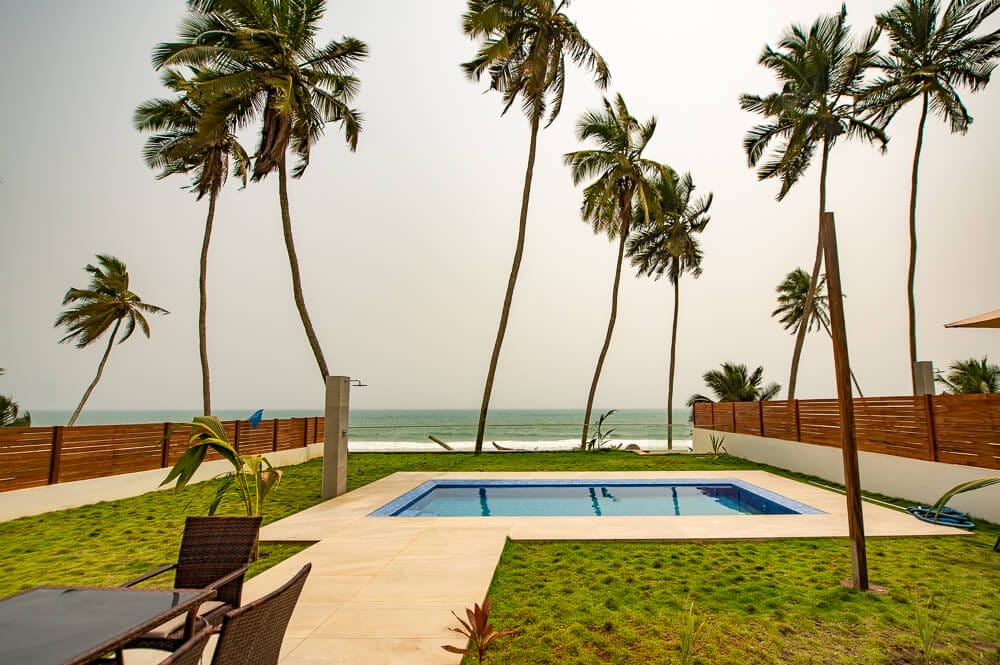
Already, the ripple effects are evident. In areas such as East Cantonments and Airport Residential, which offer easier access to the coastline land prices have seen consistent appreciation, while elite developers now scout farther out to Ada Foah, where riverfront and beachfront villas are redefining second-home luxury. These aren’t speculative builds, they are branded experiences tailored to ultra-affluent clients, offering everything from private boat slips to helipad-ready rooftops.
Underlying this growth is Ghana’s sophisticated and increasingly active diaspora. Since the country launched the “Year of Return” in 2019, it has seen over $3.3 billion in tourism-related investment, much of it from high-net-worth Ghanaians abroad. A substantial share of that capital has moved into luxury real estate, with a growing trend toward coastal estates—both as legacy holdings and as income-generating short-let properties during high seasons.
Infrastructure has not lagged behind. The government has begun expanding key access roads and planning for coastal highway enhancements that would link Accra to outlying hubs such as Ada and Keta, opening up virgin land to elite residential and resort development. These highway investments are not merely logistical—they are capital multipliers that will accelerate the viability of private estates, eco-lodges, and marina-style developments.
In parallel, Ghana’s legal landscape has improved significantly for foreign and diaspora investors. The Ghana Investment Promotion Centre (GIPC) and Lands Commission have streamlined land registration and foreign ownership protocols.
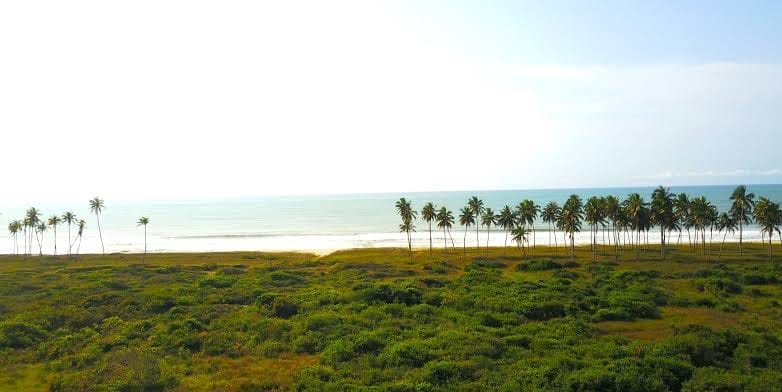
Investors can acquire long leaseholds of up to 50 years (renewable), and the repatriation of profits and proceeds is protected under the Ghanaian Investment Act. For wealth holders seeking hard assets in politically stable jurisdictions, this level of structural security is increasingly rare.
What makes Ghana’s Atlantic coast especially attractive is its emotional equity. From the cultural sanctity of Cape Coast and Elmina to the modern revival of beachfront nightlife in Osu, there is a sense of both history and forward motion. Investors are not just acquiring property; they are participating in a cultural continuum. For the diasporic elite, in particular, this is about more than luxury. It is about return, belonging, and legacy stewardship.
The architecture tells this story too. Contemporary projects balance Afro-modernist minimalism with traditional textures—earth-toned façades, open-air courtyards, and sea-salt breezeways.
High-end developers are partnering with local artisans, integrating renewable energy systems, and embedding ESG-compliant practices to meet the expectations of global family offices and private equity-backed real estate funds.
In this context, Ghana’s coastline is no longer a blank canvas. It is an intelligent, emotionally resonant, and data-anchored real estate thesis. For sophisticated investors seeking uncorrelated assets, dollar-hedged opportunities, and authentic lifestyle depth, Ghana’s Atlantic front now rivals and, in many cases, outperforms comparable corridors in Africa and beyond.
This is the luxury of alignment: between land and culture, between policy and ambition, between legacy and liquidity. And along Ghana’s golden shore, it is quietly becoming one of the continent’s most elegant investment narratives.