
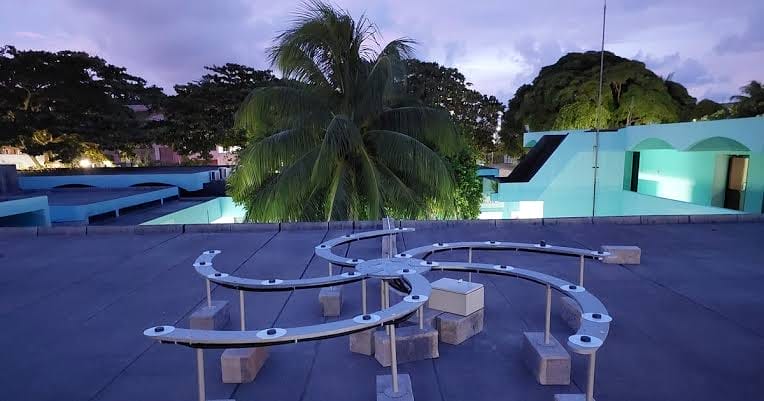

Zambia has made a significant leap in its space science ambitions with the unveiling of its first Transient Array Radio Telescope (TART), positioning the country among a growing number of African nations investing in advanced space observation technologies. Installed at Copperbelt University in Kitwe, the facility marks a strategic move to build local capacity in satellite tracking, space weather monitoring, and radio astronomy research.
ALSO READ: NERC Transfers Regulatory Oversight of Abia Electricity Market to ASERA
The newly launched TART array comprises 24 antenna elements and is designed to scan the entire sky in real time. It enables the monitoring of transient space phenomena, such as fast-moving satellites, near-Earth objects, and cosmic radio bursts helping Zambia develop capabilities critical to its national security, environmental resilience, and scientific advancement.
This development makes Zambia the fifth country in Africa to host a TART installation, following Botswana, Kenya, Mauritius, and South Africa. The initiative is a collaborative effort between Zambia’s academic institutions and international partners, including New Zealand’s Electronics Research Foundation, the South African Radio Astronomy Observatory (SARAO), and the DARA (Development in Africa with Radio Astronomy) program. These collaborations are geared toward both technology transfer and human capital development.
As part of the project rollout, academic staff and students from Copperbelt University, Mulungushi University, Kwame Nkrumah University, and Mukuba University have undergone specialized training in radio astronomy and data processing. This aligns with the government’s broader vision to foster a skilled local workforce that can lead Zambia’s emerging space sector.
The TART initiative complements Zambia’s growing space infrastructure, notably the national ground receiving station commissioned last year in Chibombo District. Developed at a cost of approximately USD 14 million, the station provides satellite telemetry and earth-observation data, supporting decision-making across sectors such as agriculture, mining, water resource management, and forestry. According to the Ministry of Technology and Science, the facility has already begun operations and is part of a long-term strategy to enhance Zambia’s independence in data collection and geospatial analysis.
ALSO READ: Zambia Hosts Inaugural AfCFTA Digital Trade and Services Forum
Minister of Technology and Science Felix Mutati has stated that Zambia is now transitioning from being a passive recipient of space data to becoming an active player in the global space economy. “We are no longer borrowing space, we are building it,” he said in reference to the shift toward homegrown innovation and investment in satellite infrastructure.
Looking ahead, Zambia plans to launch its first earth observation satellite within the next two years. This milestone will be supported by a national space science policy currently under development by the National Remote Sensing Centre (NRSC). The policy aims to provide a comprehensive framework for the country’s space strategy, focusing on four key pillars: data infrastructure, financing and human capital, service offerings, and research and development.
The NRSC has already begun applying satellite imagery for national development projects, including monitoring deforestation, assessing land use, and analyzing drought risks. Training programs in Geographic Information Systems (GIS) and remote sensing have also been extended to government officials and academics, strengthening the institutional base needed to sustain Zambia’s space agenda.
Zambia’s participation in the broader continental space dialogue, through platforms like the NewSpace Africa Conference, further underscores its commitment to aligning national objectives with regional and global space innovation trends.
As space technology continues to evolve, Zambia’s integrated approach combining infrastructure, education, policy, and partnerships signals its readiness to take on a more prominent role in Africa’s space ecosystem. The TART installation, ground receiving station, and satellite development pipeline all point toward a future in which Zambia is not only observing the skies but also contributing meaningfully to the science and economy of space exploration.