
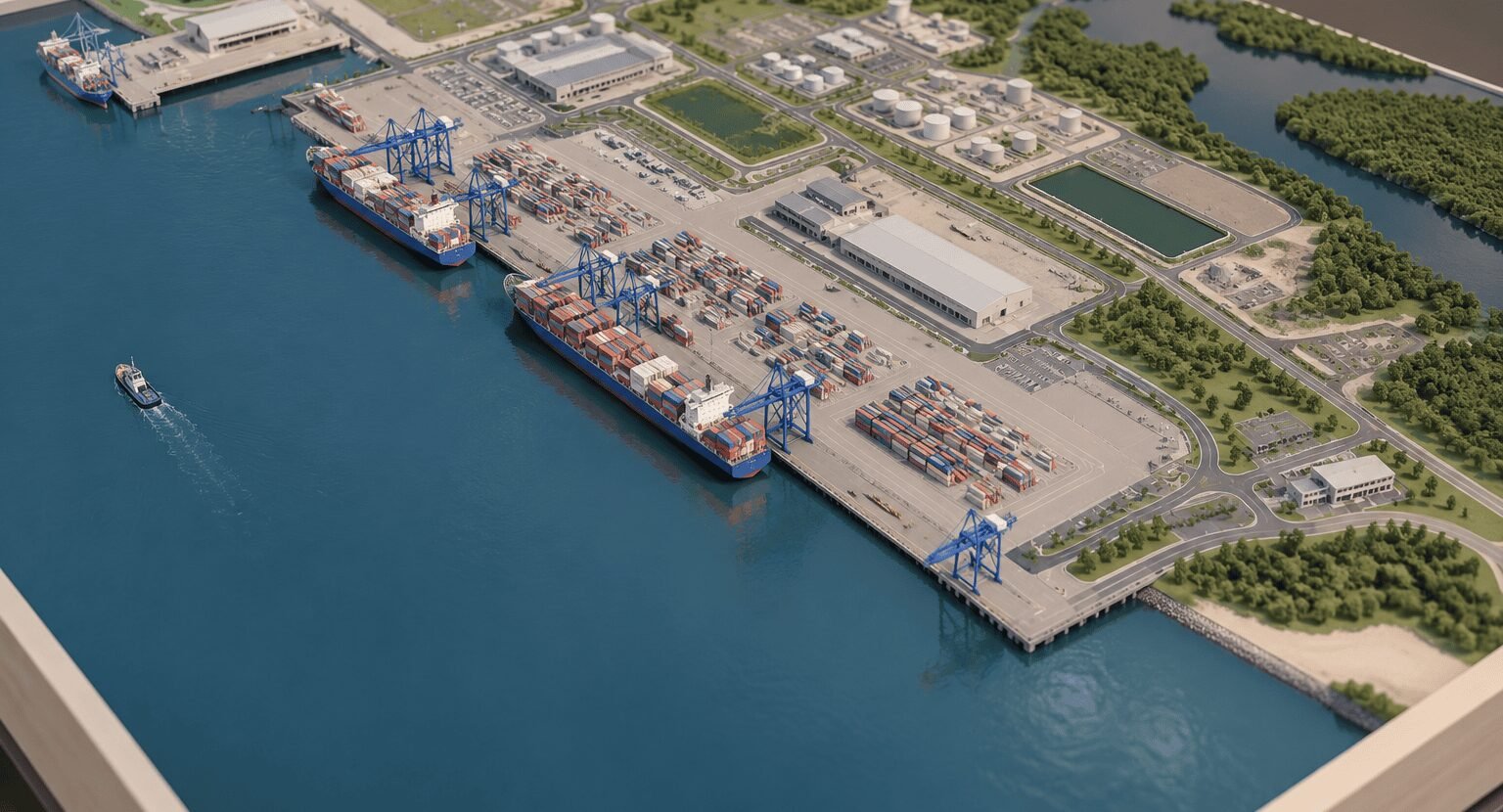

Guinea is seeking international investment for a proposed $1.9 billion deep-water port designed to strengthen its position in regional trade, expand industrial activities and reduce its dependence on infrastructure dedicated exclusively to mineral exports. The West African country intends to build on the economic opportunities created by the Simandou iron ore project while developing infrastructure accessible to businesses across multiple industries.
According to Reuters on November 16, 2026, Guinea’s Minister of Mines and Geology, Bouna Sylla, confirmed that feasibility studies had been completed and discussions were underway with American, Chinese, multilateral and private financiers. The proposed facility will have a 20-metre draft, allowing it to accommodate large vessels of up to 200,000 metric tonnes.
The Guinea Deep-Water Port forms part of a wider ambition to transform the country’s mineral wealth into sustainable economic opportunities. As production expands under the Simandou Iron Ore Project, attention is turning towards how Guinea can use its geographical position, transport infrastructure and natural resources to participate more extensively in international commerce.
Guinea Deep-Water Port Forms Part of Simandou 2040 Development Strategy
The proposed multipurpose port at M’Bottiny was among the investment opportunities presented during the Simandou Mining Summit in November 2026.
On November 13, government officials held an investment roundtable involving financial institutions and potential development partners to explore funding opportunities for the project.
The initiative falls within Simandou 2040, Guinea’s long-term national development programme, which seeks to convert mining revenues and infrastructure investments into broader economic development.
The proposed port extends beyond the construction of a mineral export terminal. Local reporting on the investment summit indicates that the development would include container handling facilities, a petroleum terminal and an industrial park.
This combination could create an environment in which manufacturing companies, logistics providers and commodity traders operate within an interconnected commercial zone.
Industrial parks located near ports can provide businesses with easier access to imported machinery, production materials and international shipping services. They can also reduce the distance finished products travel before reaching export markets.
However, these advantages depend on reliable electricity, efficient customs procedures, competitive operating costs and transport connections linking production centres to the port.
The physical construction of the facility would represent only one stage of Guinea’s wider industrial development ambition.
Simandou Iron Ore Project Creates a Foundation for Economic Diversification
The Simandou Iron Ore Project is among Africa’s most significant mining developments, with investments estimated at approximately $20 billion.
Located in southeastern Guinea, Simandou contains substantial reserves of high-grade iron ore. Its development involves international mining companies and investors, including Rio Tinto and Chinese partners.
According to Rio Tinto, the project’s supporting infrastructure includes more than 600 kilometres of railway connecting mining operations to Guinea’s Atlantic coastline. The development also incorporates specialised maritime facilities for transferring iron ore onto international shipping vessels.
The infrastructure addresses one of Guinea’s longstanding economic constraints: transporting large quantities of minerals from inland deposits to international markets.
The proposed multipurpose port introduces a broader commercial objective.
While Simandou’s export infrastructure was developed primarily around iron ore production, Guinea wants its next major port investment to accommodate businesses with different transportation requirements.
Container shipping companies, agricultural exporters and industrial operators could potentially benefit from a facility designed to handle several categories of cargo.
The economic opportunity therefore extends beyond increasing the volume of minerals leaving Guinea.
It involves creating infrastructure that allows other industries to develop around the country’s existing mining investments.
Guinea’s Mining Wealth Has Not Fully Translated Into Employment Growth
Guinea’s recent economic performance illustrates the importance of connecting mining activity with other productive sectors.
The World Bank’s 2026 Guinea Economic Update reported that the country’s economy expanded by 7.3% in 2025. Increased bauxite production contributed significantly to this growth, alongside improvements in agriculture and services.
The institution projects average economic growth of approximately 9% between 2026 and 2028 as iron ore production from Simandou expands.
However, strong economic growth does not necessarily generate employment at the same pace, especially in capital-intensive industries such as large-scale mining.
Research published by the World Bank identifies agriculture, agribusiness and non-mining private enterprises as important areas for expanding employment opportunities in Guinea.
This creates a strategic reason for developing shared transport infrastructure.
A railway or port serving only mineral producers can generate considerable export revenue without establishing extensive commercial connections with smaller domestic businesses.
Infrastructure accessible to multiple industries offers a different opportunity. It can support agricultural processing, equipment distribution, warehousing and transportation services, creating commercial activities outside mining concessions.
The Guinea Deep-Water Port could contribute to this transition if local enterprises gain affordable access to its facilities.
Don’t Miss This:
Carrefour Targets Nigeria and Guinea in West Africa Expansion Drive
Bouna Sylla Seeks Diversified Financing for Guinea’s Port Development
Guinea’s Minister of Mines and Geology, Bouna Sylla, has become a central figure in the government’s efforts to attract investment into infrastructure supporting the country’s natural resources and industrial ambitions.
His responsibilities include engaging international mining companies and development partners whose investments could influence Guinea’s economic direction.
The proposed port has attracted reported interest from potential financiers, including the US International Development Finance Corporation, Chinese investors, the World Bank Group, the African Development Bank and Africa Finance Corporation.
The government intends to structure the project through a special-purpose vehicle, a separate legal entity established to manage a specific investment or commercial development.
Such an arrangement could provide a framework for bringing together public institutions, private investors and development finance organisations.
However, the financial implications would depend on the eventual ownership structure, borrowing terms, revenue arrangements and government obligations.
Diversifying the sources of investment could reduce dependence on a single financing partner, but it would also require coordination among institutions with different commercial interests and investment requirements.
The reported interest does not constitute confirmed financing commitments.
Guinea has not announced a final investor selection, financial close or construction commencement date.
The next significant milestone will be establishing a financing agreement that supports construction without imposing unsustainable obligations on the country’s public finances.
Agriculture and Local Businesses Could Benefit From Improved Trade Infrastructure
Agriculture offers an important example of how Guinea’s port development could support economic activities outside mineral extraction.
According to the World Bank’s 2026 economic update, strengthening agricultural value chains and improving market access are among the country’s major opportunities for economic diversification.
Transport limitations can make it difficult for agricultural producers to reach processing facilities and international customers. Delays also increase the risk of losses when businesses transport perishable goods.
Improved connections between farming communities, storage facilities and maritime export terminals could help address some of these constraints.
A port capable of handling containerised cargo could provide opportunities for businesses exporting processed foods and other agricultural products.
Domestic enterprises could also benefit from improved access to imported production equipment and packaging materials.
However, the development of agricultural exports would require complementary investments in roads, cold storage, processing facilities and product certification.
The port would provide an important commercial connection, but its economic contribution would depend on the ability of producers to supply goods that meet international market requirements.
Guinea’s wider development strategy has already received support through the World Bank Group’s Country Partnership Framework for 2027 to 2033.
Announced in June 2026, the framework includes financing for commercial agriculture, workforce skills and public financial management. It also identifies the Simandou transport corridor as an opportunity to connect infrastructure investment with private-sector development.
These complementary initiatives are relevant because successful economic diversification requires businesses capable of using the infrastructure being constructed.
Guinea’s Regional Trade Ambition Will Depend on More Than Port Capacity
Guinea’s Atlantic coastline provides a geographical advantage that could support its ambition to become a regional logistics centre.
Landlocked West African economies depend on transport corridors connecting them to coastal ports for international trade. Efficient maritime facilities can therefore serve commercial activities extending beyond their host countries.
Guinea shares a border with Mali, creating potential opportunities for inland trade connections if appropriate transport infrastructure and cross-border arrangements are developed.
However, establishing a competitive regional trade hub requires more than the ability to accommodate large vessels.
Ports must provide reliable cargo handling, predictable clearance procedures and affordable access to inland destinations.
West Africa already has established maritime gateways in countries including Senegal, Côte d’Ivoire, Ghana and Togo.
Guinea’s proposed facility would therefore need to demonstrate commercial advantages capable of attracting shipping companies and regional businesses.
Its planned 20-metre draft could accommodate large bulk carriers, creating opportunities to handle significant cargo volumes. However, vessel-handling capacity alone does not establish future throughput or commercial profitability.
The effectiveness of the Guinea Deep-Water Port would depend on cargo demand, operational efficiency and its integration with wider regional transport networks.
What This Means For Africa
Guinea’s proposed port development highlights an important issue in African infrastructure investment: how to ensure that facilities financed around natural resources also support broader economic development.
Across several African economies, mining projects have encouraged the construction of railways, roads and export terminals. These investments can generate foreign exchange and improve access to international markets, but their wider economic benefits depend partly on how accessible they are to other industries.
The relationship between the Simandou Iron Ore Project and Guinea’s proposed multipurpose port illustrates the possibility of developing infrastructure that serves commercial activities beyond mineral extraction.
Shared facilities could reduce the need for individual businesses to finance separate transport systems, potentially lowering barriers to industrial investment.
For African manufacturers, the availability of efficient ports is important because transportation costs influence the competitiveness of locally produced goods.
The African Continental Free Trade Area also creates a wider framework within which improved transport connections could support trade between African economies. Its commercial potential depends partly on the infrastructure available to move products across national borders.
Guinea’s engagement with American, Chinese and multilateral financiers introduces another important consideration: how African countries structure international infrastructure partnerships to serve their long-term development objectives.
Transparent financing agreements, competitive procurement, environmental safeguards and equitable access will be essential to determining the proposed port’s wider economic value.
The project could also provide lessons for other resource-rich African countries seeking to develop domestic processing industries without relying exclusively on commodity exports.
Ultimately, the significance of Guinea’s $1.9 billion port ambition will extend beyond its construction cost or the size of vessels it can accommodate.
Its long-term economic contribution will be measured by the local businesses it supports, the industries it enables, the employment opportunities it generates and the regional markets it connects.
For Guinea, the opportunity is to turn infrastructure originally driven by mineral wealth into a foundation for a more diversified economy.
Don’t Miss This:
Guinea, Emirates Global Aluminium Near Deal to Resolve Asset Dispute