
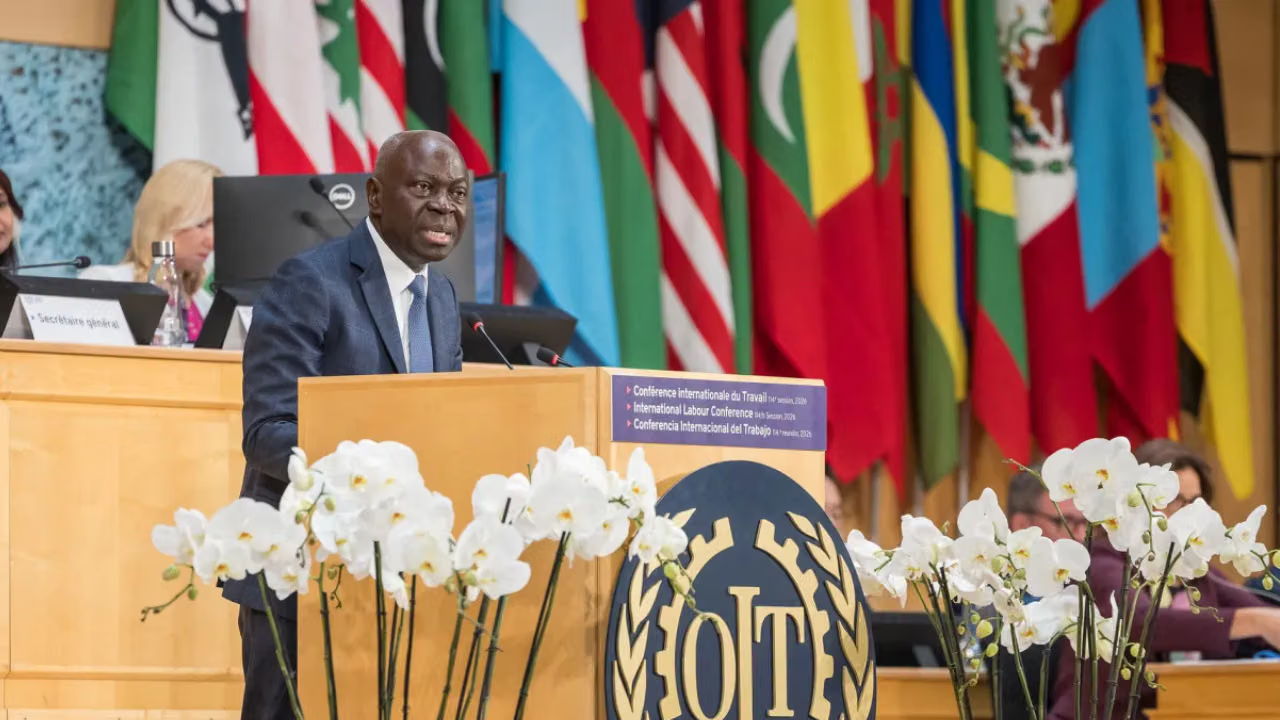

Togo’s Gilbert Fossoun Houngbo has secured a second five-year term as Director-General of the International Labour Organization (ILO), extending his leadership of the United Nations agency responsible for advancing international labour standards, employment opportunities and social protection. His re-election comes as artificial intelligence transforms workplace practices and financial pressures threaten the organisation’s operations.
According to Reuters, Houngbo received 51 of the 56 votes cast during the ILO Governing Body election in Geneva on November 16, 2026, with five abstentions. His second mandate will begin on October 1, 2027. The Togolese leader identified artificial intelligence and its transformation of labour markets as a major challenge facing the organisation.
The re-election of the ILO Director-General comes at an important period for developing economies, where technological progress must be balanced against existing employment challenges. Across Africa, the debate surrounding Artificial Intelligence and Jobs extends beyond automation to questions of digital access, workforce development, employment quality and economic inclusion.
From Togo to the Leadership of a Global Labour Institution
Gilbert Fossoun Houngbo became the first African to lead the International Labour Organization when he assumed office in October 2022, following his election in March of that year.
Before joining the ILO, Houngbo served as Prime Minister of Togo between 2008 and 2012 and later as President of the International Fund for Agricultural Development (IFAD). His professional background spans public administration, international development and economic policy.
His experience in agricultural development is especially relevant to labour discussions involving developing economies, where agriculture remains an important source of employment and household income.
Founded in 1919, the ILO operates through a distinctive tripartite structure that brings governments, employers and workers’ representatives together to develop labour standards and address employment-related challenges.
Its responsibilities include promoting occupational safety, protecting workers’ rights, supporting social dialogue and helping countries establish policies that improve employment conditions.
As ILO Director-General, Houngbo leads an institution whose work extends beyond conventional employment relationships to include informal workers, agricultural communities and people facing barriers to economic participation.
His second term will extend this leadership into 2032, a period during which technological developments are expected to continue changing how businesses operate and how workers develop their careers.
Artificial Intelligence and Jobs Become Central to Global Labour Policy
The employment implications of artificial intelligence have become a major area of research within the ILO.
A joint study published in May 2025 by the organisation and Poland’s National Research Institute found that approximately one in four workers worldwide holds an occupation with some degree of exposure to generative artificial intelligence.
However, exposure does not necessarily mean that a worker will lose their job. The research identifies changes to occupational responsibilities as a more likely outcome than the complete replacement of most affected roles.
This distinction is central to understanding Artificial Intelligence and Jobs.
Administrative employees, accountants, software developers and media professionals may experience changes in how they perform particular tasks as businesses introduce AI-powered tools. Their responsibilities could shift towards supervision, verification, decision-making and activities requiring human judgement.
Employers may benefit from increased productivity, but workers could face pressure to acquire additional skills or adapt to changing professional expectations.
The challenge for labour institutions is ensuring that technological adoption does not undermine employment standards or exclude workers who lack access to training.
Questions surrounding employee monitoring, automated recruitment, workplace data protection and accountability for AI-generated decisions are also becoming relevant to employment policy.
The ILO’s future contribution will involve helping governments, employers and workers navigate these developments while maintaining established labour protections.
Africa’s Digital Divide Creates a Different Employment Challenge
The impact of artificial intelligence is unlikely to be uniform across economies.
The ILO’s 2025 research estimated that around 34% of employment in high-income countries had some exposure to generative AI, compared with approximately 11% in low-income countries.
Differences in occupational structures contribute to this gap. Economies with larger concentrations of administrative, professional and technology-related jobs generally have more workers performing tasks that current generative AI systems can assist or automate.
However, lower exposure should not automatically be interpreted as an economic advantage for developing countries.
Limited internet connectivity, expensive digital infrastructure and unequal access to technology can prevent workers and businesses from benefiting from AI-enabled productivity improvements.
An African agricultural enterprise, for example, could potentially use artificial intelligence to analyse market information, improve inventory management or support customer communication. Its ability to adopt these technologies would depend on access to reliable infrastructure, suitable tools and employees with the necessary skills.
Smaller enterprises may encounter additional challenges because of financing constraints and limited technical capacity.
The relationship between Artificial Intelligence and Jobs in Africa therefore involves two interconnected concerns: protecting workers from harmful technological disruption and ensuring that businesses and employees are not excluded from the economic opportunities generated by innovation.
Without improvements in digital access and education, technological advancement could widen productivity differences between businesses and economies.
Don’t Miss This:
Togo Updates Sahel Plan as West Africa Faces Security and Political Changes
Africa’s Young Workforce Faces Challenges Beyond Automation
Africa’s employment priorities differ in important ways from those of many advanced economies.
While some wealthier countries are confronting automation alongside ageing populations, several African economies must generate employment opportunities for growing numbers of young people entering the labour market.
The ILO’s 2026 reporting on youth employment identified sub-Saharan Africa as a region experiencing significant demographic pressures alongside insufficient opportunities for decent employment.
In Northern Africa, youth unemployment reached 22.6% in 2025, illustrating another dimension of the continent’s employment challenges.
Informal employment further complicates the transition.
Workers operating outside formal employment arrangements often have limited access to stable earnings, pension contributions, unemployment protection and structured professional training.
Introducing artificial intelligence into such labour markets requires attention to these existing conditions.
Digital platforms may create opportunities for freelancers, entrepreneurs and small businesses to reach customers across national borders. However, platform-based work can also raise questions about income stability, contractual responsibilities and employment protections.
An AI-driven economy could create new professional opportunities while simultaneously changing the entry-level roles through which young people traditionally acquire workplace experience.
African education systems and employers will therefore need to examine how professional training can develop technical competence alongside communication, critical thinking and problem-solving abilities.
Under Houngbo’s leadership, the ILO’s research and technical cooperation could help inform national policies addressing these challenges.
International Labour Organization Faces Funding Pressures During Technological Transition
Houngbo’s second election victory comes while the ILO confronts financial uncertainty linked to unpaid United States contributions.
The United States has traditionally been one of the organisation’s most important financial supporters. Reuters reported that outstanding payments have raised concerns about possible workforce reductions within the agency.
The funding dispute is part of a broader reassessment of United States financial commitments to international institutions under President Donald Trump’s administration, which has called for reforms to address perceived inefficiencies.
There have also been disagreements over the ILO’s management of its financial difficulties.
Spanish Labour Minister Yolanda Díaz, who withdrew from the leadership contest before the election, criticised the organisation’s current direction and its handling of the crisis.
Her criticism establishes a competing assessment of the institution’s leadership, although Houngbo ultimately secured a strong majority among participating voters.
The financial challenges carry potential consequences beyond the ILO’s Geneva headquarters.
International labour research, technical assistance, policy development and country-level programmes require institutional resources.
Reduced funding could place pressure on some of these activities, depending on the organisation’s budgetary decisions and its ability to secure alternative financial support.
Developing countries may be especially affected if technical cooperation programmes become more limited at a time when governments need assistance responding to technological change and employment pressures.
The precise scale of any future programme reductions remains uncertain.
The ILO Director-General must therefore manage two interconnected responsibilities: maintaining the organisation’s operational capacity and ensuring that its labour standards remain relevant to a rapidly changing global economy.
Houngbo’s Second Term Will Test International Cooperation on Employment
Artificial intelligence introduces employment questions that individual governments may struggle to address independently.
Digital businesses increasingly operate across national borders, connecting workers, employers and customers through international platforms. These arrangements can create uncertainty over which labour regulations apply and how workers can protect their rights.
The ILO provides a forum through which countries, employers and workers can discuss common approaches to evolving employment practices.
Its tripartite structure is relevant because technological adoption involves interests that do not always align automatically.
Businesses may prioritise efficiency and competitiveness, while workers may be concerned about job security, wages and professional development. Governments must balance these interests with broader economic objectives.
Effective social dialogue can help establish how technological changes are introduced, what training is provided and how productivity gains are distributed.
Houngbo’s previous public statements have emphasised the importance of placing decent work at the centre of AI adoption.
At the Artificial Intelligence Action Summit in Paris in February 2025, he called for an approach that improves productivity while protecting worker well-being.
His second mandate offers continuity for that agenda, although delivering measurable results will require cooperation from member states, employers and labour organisations.
The effectiveness of his leadership will also depend on the ILO’s financial position and the willingness of international partners to maintain support for its activities.
What This Means For Africa
Houngbo’s re-election maintains African leadership at an international institution whose decisions and research influence employment policies across the world.
However, its significance extends beyond representation.
Africa’s economic development will depend partly on its ability to generate productive employment while participating in technological advances that are changing global industries.
The debate surrounding Artificial Intelligence and Jobs presents opportunities for African businesses to improve productivity, develop new services and participate in international digital markets.
These opportunities must be supported by investments in education, electricity, internet connectivity and affordable technology.
Governments also face the responsibility of developing employment frameworks that protect workers without unnecessarily restricting innovation.
The continent’s informal economy deserves particular attention.
Policies designed exclusively around salaried employees in established companies may overlook the realities of traders, agricultural workers, independent contractors and small business owners.
Extending social protection and professional development opportunities to these groups could help ensure that technological progress reaches a wider proportion of the workforce.
International labour cooperation also has implications for Africa’s industrialisation and regional trade ambitions under the African Continental Free Trade Area.
Businesses expanding across African markets will require skilled employees, reliable labour institutions and employment conditions that support sustainable commercial growth.
The continued presence of an African ILO Director-General provides an opportunity for the continent’s employment experiences to remain visible within international policy discussions. However, representation alone cannot guarantee favourable outcomes or replace national action.
African governments, businesses and educational institutions will remain responsible for translating international labour discussions into practical employment strategies.
The central issue is not simply how many jobs artificial intelligence could replace. It is how African economies can use emerging technologies to create productive work, strengthen businesses and improve living conditions without leaving vulnerable workers behind.
Houngbo’s second term begins in October 2027. Its wider significance will be measured by the organisation’s ability to help countries manage technological transformation while advancing decent employment, economic participation and social protection.
Don’t Miss This: