
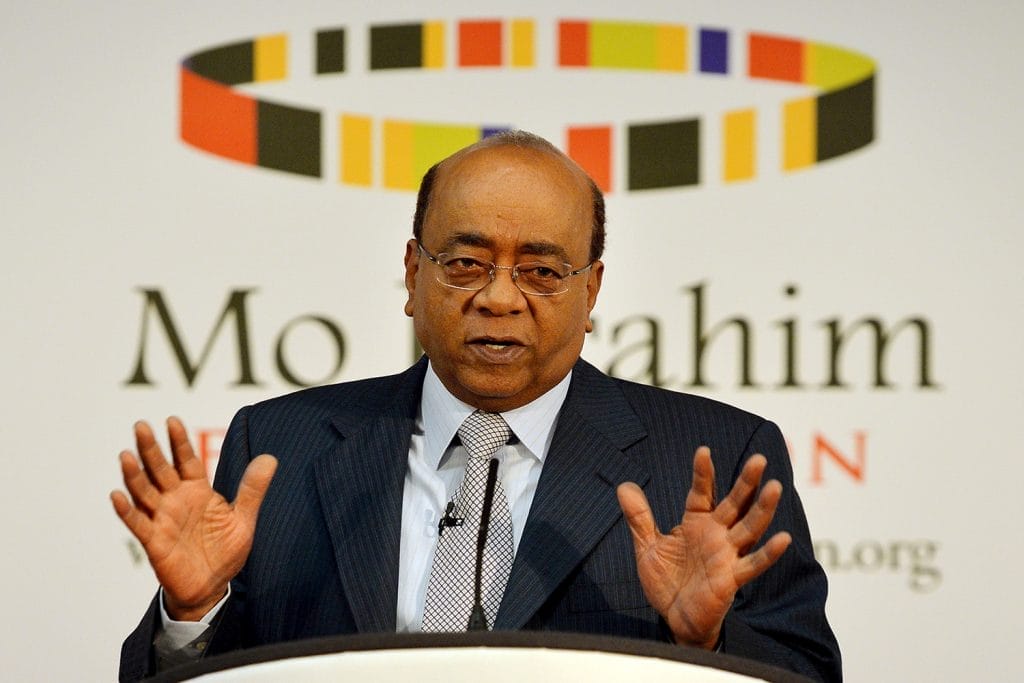

If wealth were measured not just in currency but in integrity, Dr. Mo Ibrahim would still rank among Africa’s richest men. A telecommunications tycoon turned governance crusader, Ibrahim is that rare figure in global business, a man who built a billion-dollar empire and then stepped away, not into quiet retirement, but into one of the continent’s most vital and noble causes: accountability.
Born in Sudan in 1946 and raised in Egypt, Mohamed “Mo” Ibrahim trained as an electrical engineer before earning a PhD in mobile communications at the University of Birmingham.
A quintessential technocrat with a penchant for systems thinking, Ibrahim understood early that Africa’s future would be shaped not only by natural resources, but by digital access and sound leadership.
In 1998, he founded Celtel International, a mobile telecommunications company that defied precedent by focusing not on lucrative Western markets, but on the underserved heart of Africa.
From Zambia to the Democratic Republic of Congo, Celtel introduced mobile networks in some of the continent’s most remote regions, connecting over 15 million people across 14 countries. His model was revolutionary, not just in its business logic, but in its corporate ethics. Celtel paid taxes transparently, avoided bribery, and insisted on principled local partnerships, setting a new benchmark for doing business in Africa.
When Ibrahim sold Celtel for $3.4 billion in 2005, he could have faded into a life of luxury. Instead, he redirected his energy—and his fortune—toward one of Africa’s thorniest challenges: governance.
That same year, he launched the Mo Ibrahim Foundation, with a bold and unconventional mission: to improve leadership across the continent by incentivizing ethical governance and recognizing excellence in public service.
The centerpiece of his foundation is the Ibrahim Prize for Achievement in African Leadership—an award that offers a $5 million grant (plus a lifetime stipend) to democratically elected African heads of state who leave office peacefully and have demonstrably improved the lives of their citizens.
It is the world’s largest individual award in terms of monetary value, yet it is rarely awarded, underscoring the foundation’s unyielding standards.
Beyond the prize, the foundation publishes the Ibrahim Index of African Governance, a data-rich assessment tool used by policymakers, researchers, and global institutions to monitor the quality of governance across all 54 African countries.
It has become a respected barometer for measuring progress—and regress—on everything from security and justice to economic opportunity and human rights.
Despite his enormous wealth and accolades including honorary doctorates, international prizes, and a place among Time Magazine’s 100 Most Influential People, Mo Ibrahim carries himself with striking humility.
Sharp-witted, outspoken, and often disarming in public forums, he speaks not in abstractions, but in truths. For him, the road to prosperity in Africa is inseparable from transparency, institutional strength, and the rule of law.
Mo Ibrahim is not merely a success story—he is a philosophical force in African entrepreneurship. He represents a generation of leaders who believe that capitalism must serve the public good, and that prosperity, to be enduring, must be anchored in justice.
In an age where too many seek short-term gains, Ibrahim’s legacy is rooted in long-term transformation—a quiet revolution led not by power, but by principle.