
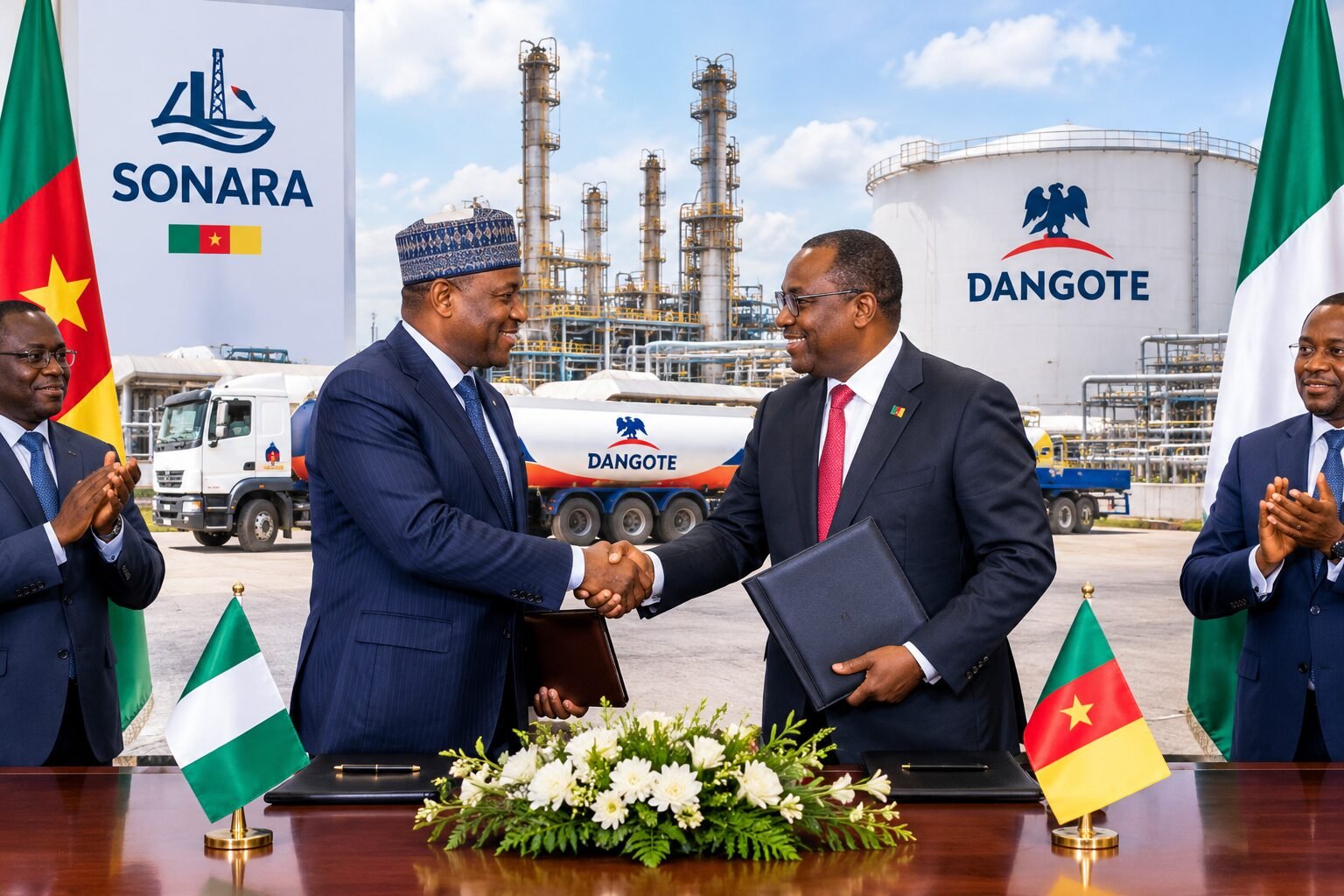

Cameroon’s state-owned oil refining company, Société Nationale de Raffinage, known as SONARA, has signed a fuel supply agreement with Nigeria’s Dangote Group and MRS Oil & Gas Company to strengthen the country’s access to refined petroleum products, as reported by CNBC Africa. The agreement was signed in Lagos on October 22, 2026, and formally presented in Cameroon a week later. The arrangement is designed to establish a more stable and sustainable supply of petrol, diesel and other petroleum products as Cameroon seeks to reduce its exposure to international market volatility and rising fuel costs. Local Cameroonian reports indicate that the agreement will run for 30 months, although the companies have not publicly disclosed the specific supply volumes or financial value of the arrangement.
The partnership comes as Cameroon continues to depend heavily on imported refined petroleum products following the 2019 explosion and fire that damaged SONARA’s only refinery in Limbe, forcing the facility to suspend operations. The disruption left the country reliant on international suppliers to meet domestic demand, exposing its energy market to fluctuations in global prices and logistical challenges. According to Reuters, SONARA described the new arrangement as an effort to secure a stable supply amid rising petroleum costs linked to the conflict in the Middle East. The involvement of MRS Oil & Gas is expected to support the commercial and logistical distribution of products within the Cameroonian market.
For Dangote Group, the agreement represents another expansion of its growing presence in Africa’s downstream petroleum market, positioning its Lekki-based refinery as an increasingly important supplier to neighbouring and regional economies. In March 2026, the refinery exported approximately 456,000 tonnes of petroleum products to African markets, including Cameroon, Côte d’Ivoire, Tanzania, Ghana and Togo. Its growing export capacity is attracting interest from countries seeking to diversify fuel supply sources and strengthen energy security. The Cameroon agreement further demonstrates the commercial opportunities created by regional refining capacity, while opening another channel for Nigerian petroleum products to serve African markets.