
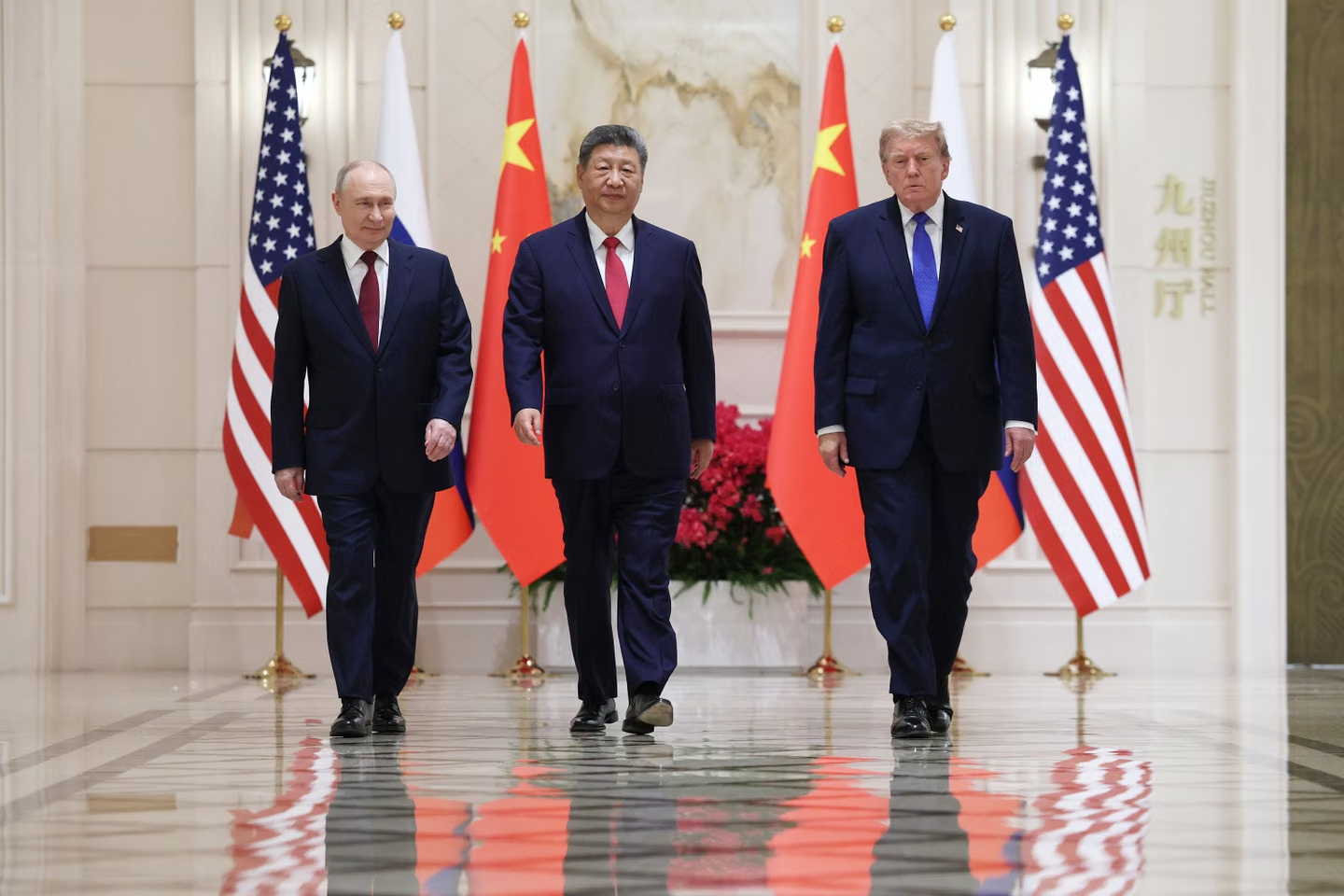

The United States, China and Russia have issued a joint declaration committing to international security, nuclear risk reduction and stronger energy cooperation following the first ever trilateral summit between their presidents in Shenzhen, China, on 19 November 2026. US President Donald Trump, Chinese President Xi Jinping and Russian President Vladimir Putin held the historic meeting on the sidelines of the 2026 Asia-Pacific Economic Cooperation summit, producing a four point agreement titled the China-Russia-US Heads of State Declaration Toward Peace. According to the official statement published by the White House and China’s Ministry of Foreign Affairs, the three permanent members of the United Nations Security Council agreed to pursue reforms that would make the UN more effective in addressing global challenges, increase the production and supply of refined petroleum products, uphold state sovereignty and official immunities in international legal proceedings, and establish dialogue on reducing nuclear risks and preventing nuclear proliferation. The leaders also reaffirmed that a nuclear war cannot be won and must never be fought.
Beyond its diplomatic significance, the agreement carries potential implications for global energy markets, international trade and investment. The commitment to increase refined petroleum production and maintain stable energy flows is particularly significant given the influence of the three countries across global energy supply chains. Russia remains a major oil and gas producer, the United States is a leading producer of crude oil and natural gas, while China is one of the world’s largest energy consumers and refining markets. Greater coordination among the three economies could influence petroleum availability, international energy prices and supply security, although the declaration provides no production targets, investment commitments or implementation timetable. Reuters reported that the summit also produced no concrete breakthrough on nuclear arms reduction negotiations, which Washington has previously sought to advance with Moscow and Beijing. The declaration similarly made no direct reference to Russia’s ongoing war in Ukraine or the conflict involving the United States and Iran, highlighting the limits of the agreement despite its historic symbolism.
For Africa, the outcome presents both opportunities and uncertainties. The continent remains exposed to movements in global oil prices, international shipping costs, foreign exchange markets and geopolitical tensions, while major economies such as Nigeria, Angola and Libya have significant interests in the global petroleum industry. Greater stability in relations among the three powers could support more predictable energy markets, improve the environment for international investment and create opportunities for African oil producers and exporters. However, increased refined petroleum supplies from the three countries could also intensify competition for African refineries and petroleum suppliers seeking to expand their market positions. The next important test will be whether the declaration translates into measurable cooperation on energy supply, nuclear risk reduction and international diplomacy. As Al Jazeera noted in its assessment of the summit, the agreement remains largely symbolic without concrete mechanisms or timelines. For African governments, energy companies and investors, the significance will ultimately depend less on the historic gathering itself and more on whether its commitments produce tangible changes in global trade, energy security and economic stability.