
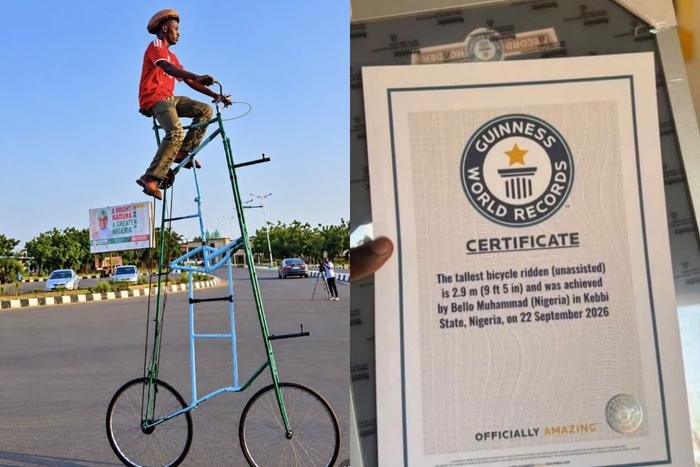

A young Nigerian cyclist, Bello Muhammad from Kebbi State, has earned international recognition after setting a Guinness World Record for riding the tallest bicycle unsupported, measuring 2.9 metres (9 feet 5 inches). Muhammad achieved the feat on September 22, 2026, in Kebbi State, after reportedly fabricating the towering bicycle himself and successfully mounting, riding and dismounting it without assistance. According to Channels Television, the achievement was formally celebrated at the Kebbi State Government Secretariat in Birnin Kebbi, where the cyclist’s Guinness World Records certificate was presented to state officials. His accomplishment places a spotlight on the technical creativity and determination of young Nigerians pursuing unconventional ambitions.
The Patron of the Kebbi State Equity Cyclist Association, Abubakar Kalgo, said Muhammad designed and constructed the bicycle himself, demonstrating the technical ability and balance required to operate a machine of that height without external support. The certificate was presented to the state government, represented by Head of Service Malami Shekare, on behalf of Governor Nasir Idris. During the recognition ceremony, Shekare congratulated Muhammad and announced a ₦1 million donation in acknowledgement of his achievement. The state’s Commissioner for Information and Culture, Yakubu Ahmed-BK, also commended the cyclist, describing the record as a source of international recognition for Kebbi and an example of the potential of its young people.
Beyond the record itself, Muhammad’s achievement highlights the possibilities that emerge when sporting talent intersects with fabrication, engineering and practical innovation. His ability to build and ride the bicycle demonstrates skills extending beyond conventional cycling, while the recognition has renewed attention on youth talent development in Kebbi State. For Nigeria, the accomplishment adds to a growing catalogue of individuals gaining international recognition through distinctive achievements, while reinforcing the importance of creating opportunities for young people to develop technical abilities and pursue ambitious projects. Muhammad’s record is a reminder that innovation and extraordinary talent can emerge from communities across the country, often far beyond the traditional centres of opportunity.